
* Chemical reactions of the elements
Reaction of zinc with air:
Zinc metal tarnishes in moist air. Zinc metal burns in air to form the white zinc(II) oxide, a material that tirns yellow on prolonged heating.
2Zn(s) + O2(g) → 2ZnO(s) [white]
Reaction of zinc with water:
Zinc does not react with water.
Reaction of zinc with the halogens:
Zinc dibromide, zinc(II) dibromide, ZnBr2, and zinc diiodide, zinc(II) dibiodide, NiI2, are formed in the reactions of zinc metal and bromine, Br2, or iodine, I2.
Zn(s) + Br2(g) → ZnBr2(s) [white]
Zn(s) + I2(g) → ZnI2(s) [white]
Reaction of zinc with acids:
Zinc metal dissolves slowly in dilute sulphuric acid to form solutions containing the aquated Zn(II) ion together with hydrogen gas, H2. In practice, the Zn(II) is present as the complex ion [Zn(OH2)6]2+.
Zn(s) + H2SO4(aq) → Zn2+(aq) + SO42-(aq) + H2(g)
The reacts of zinc with oxidizing acids such as nitric acid, HNO3, are complex and depend upon precise conditions.
Reaction of zinc with bases:
Zinc metal dissolves in aqueous alkalis such as potassium hydroxide, KOH, to form zincates such as [Zn(OH)4]2-. The resulting solutions contain other species as well.
Tuesday, March 30, 2010
Tuesday, December 1, 2009
MCQ
1. What is the definition of a transition metal?
- An element that has its s orbitals partially filled
- An element that has its p orbitals partially filled
- An element that has its d orbitals partially filled
- An element that has its f orbitals partially filled
2. Which of the following statements about transition metals is true?
- Typical transition metals have boiling points greater than 1000°C
- Typical transition metals have melting points greater than 1000°C
- Typical transition metals have melting points less than 1000°C
- Transition metals are less dense than Group I metals
3. What is the electronic configuration of Cr?
- [Ar] 3d3 4s2
- [Ar] 3d5 4s2
- [Ar] 3d4 4s2
- [Ar] 3d5 4s1
4. Why is Mn2+ not readily oxidised to Mn3+?
- This is because the electronic configuration of Mn2+ is more stable than that of Mn3
- This is because the electronic configuration of Mn2+ is less stable than that of Mn3
- This is because Mn2+ does not have any more electrons in its d orbitals
- This is because the Mn2+ cannot accept any more electrons in to its d orbital
5. In which order are the third and fourth level s, p and electrons filled in?
- 3s, 3p, 3d, 4s
- 3s, 3p, 4s, 3d
- 3s, 4s, 3p, 3d
- 4s, 3s, 3p, 3d
6. Which transition metal shows the greatest variation in possible oxidation numbers?
- V
- Cr
- Mn
- Fe
7. Why is Fe3+ more stable than Fe2+?
- The Fe3+ ion has amore stable 3d5 4s1 electronic configuration
- The Fe2+ ion has amore stable 3d5 4s1 electronic configuration
- The Fe3+ ion has a more stable 3d5 4s2 electronic configuration
- The Fe3+ ion has a more stable 3d4 4s2 electronic configuration
8. Some transition metals exhibit paramagnetism. What does this mean?
- The metal is attracted to a magnet
- The metal is repelled by a magnet
- The metal acts like the north pole of a magnet
- The metal acts like the south pole of a magnet
9. Which of the following statements about catalysts is true?
- Catalysts change the equilibrium position of a reaction
- Catalysts are always used to slow down reaction rates
- Catalysts are not consumed by the reaction they take part in
- Catalysts can be recovered from a reaction and regenerated by performing a simple chemical reaction
10. What is meant by the term 'ligand'?
- A substance that can donate a lone pair of electrons to form a dative bond
- A substance that can accept a lone pair of electrons to form a dative bond
- A substance that can accept a lone pair of electrons to form hydrogen bond
- A substance that can donate a lone pair of electrons to form a hydrogen bond
11. When aqueous ammonia is added to a solution of copper II sulphate the pale blue solution changes to a dark blue colour. What is the formula of the complex formed?
- [Cu(H2O)6]2+(aq)
- [Cu(NH3)4(H2O)2]2+(aq)
- [Cu(NH3)2(H2O)4]2+(aq)
- [Cu(NH3)6]2+(aq)
Monday, November 23, 2009
d block questions
Give reasons for the following questions related to transition elements:
1. Transition metals form alloys with other transition metals easily.
2. Melting points of transition metals increase up to the middle of the series
and then decrease.
3. Transition metals and their compounds are good catalysts.
4. Zn, Cd and Hg are softer and volatile metals.
5. Cr and Cu exhibit exceptional electronic configurations.
6. Transition metals have high melting points.
7. Transition metals compounds are mostly coloured.
8. Sc3+ and Zn2+ are colourless in aqueous solutions.
9. Transition metals exhibit variable oxidation states.
10. Transition metal series exhibit fewer oxidation states at their extreme ends. (Sc, Ti, Cu)
11. Density of zinc is lower than that of copper.
12. Transition metals have high enthalpy of atomisation.
13. Generally speaking, the enthalpies of atomisation and melting points transition
metals of 3d, 4d and 5d series increase steadily down the group
14. Transition metals and their compounds show paramagnetic behaviour.
15. Hydrated copper sulphate is blue where as anhydrous copper sulphate is white.
16. The magnetic moments of the transition metals increase up to the middle of the series
and then decrease.
17. Transition metals generally form complex compounds.
18. Transition metals form interstitial compounds.
19. The third ionisation enthalpies of Mn & Zn are quite high in comparison to Fe.
20. Zn has little tendency to form complexes.
21. Zn, Cd and Hg are not considered as true transition metals.
22. [Ti(H2O)6]3+ is coloured while [Sc(H2O)6]3+ is colourless.
23. Mn2+ compounds are more stable than Fe2+ compounds towards oxidation to +3 state.
24. The decrease in atomic radius in the case of any d-series is not as large as that in
period 2 or 3.
25. A transition metal exhibits higher oxidation states in oxides and fluorides.
26. The d1 configuration is very unstable in ions of d-Block elements.
27. Scandium(II) is virtually unknown.
28. The magnetic moment of Co3+ is higher than that of Co2+.
29. The lowest oxide of transition metal is basic, the highest is acidic.
30. The densities of post-lanthanoid elements are very high.
31. The atomic sizes of corresponding elements of 4d and 5d series are almost the same.
32. La3+ and Lu3+ are colourless while rest of lanthanoids are coloured in the solid
as well as in aqueous state.
33. The first-ionisation enthalpies of the 5-d transition elements are higher than those of
the 4-d metals.
34. Cu+ is diamagnetic whereas Cu2+ is paramagnetic.
35. The ionisation enthalpy of Hf (6th period) is higher than that of Zr (5th period).
36. The most common oxidation state of lanthanoids is +3. However cerium and europium form additional oxidation states of +4 and +2 respectively.
37. Ce4+ is a good oxidant.
38. Eu2+ is a good reducing agent.
II. Describe the large scale preparation of:
1. Potassium dichromate from chromite ore(FeCr2O4).
2. KMnO4 manufactured from pyrolusite.
III. Write the chemical reactions involved.
1. Acidified potassium dichromate with (a) KI solution (b) FeSO4 solution.
2. Acidified potassium permanganate with (a) oxalate solution (b) Sn2+ solution.
3. Pr + H2O
4. Ce + N2 heated
5. Lu + O2
IV. Compare the chemistry of actinoids with that of the lanthanoids with special reference to:
1. electronic configuration
2. oxidation state
3. atomic sizes
4. chemical reactivity.
V. What is lanthanoid contraction? How would you account for it?
What are its important consequences?
VI. Short Questions:
1. What are transition elements?
2. What is misch-metal?
3. Which is more stable – Mn2+ or Mn4+?
4. What are coinage metals?
5. Write the outer shell configuration of inner transition metals.
6. Calculate the magnetic moment of Mn2+.
7. Draw the structures of , Cr2O72- and CrO42-
8. Name the metal with the highest melting point.
9. Name the actinoid with no 5f electron.
10. Name the lanthanoid with the maximum paramagnetism.
11. What are the uses of lanthanoids?
12. What are transuranic elements?
1. Transition metals form alloys with other transition metals easily.
2. Melting points of transition metals increase up to the middle of the series
and then decrease.
3. Transition metals and their compounds are good catalysts.
4. Zn, Cd and Hg are softer and volatile metals.
5. Cr and Cu exhibit exceptional electronic configurations.
6. Transition metals have high melting points.
7. Transition metals compounds are mostly coloured.
8. Sc3+ and Zn2+ are colourless in aqueous solutions.
9. Transition metals exhibit variable oxidation states.
10. Transition metal series exhibit fewer oxidation states at their extreme ends. (Sc, Ti, Cu)
11. Density of zinc is lower than that of copper.
12. Transition metals have high enthalpy of atomisation.
13. Generally speaking, the enthalpies of atomisation and melting points transition
metals of 3d, 4d and 5d series increase steadily down the group
14. Transition metals and their compounds show paramagnetic behaviour.
15. Hydrated copper sulphate is blue where as anhydrous copper sulphate is white.
16. The magnetic moments of the transition metals increase up to the middle of the series
and then decrease.
17. Transition metals generally form complex compounds.
18. Transition metals form interstitial compounds.
19. The third ionisation enthalpies of Mn & Zn are quite high in comparison to Fe.
20. Zn has little tendency to form complexes.
21. Zn, Cd and Hg are not considered as true transition metals.
22. [Ti(H2O)6]3+ is coloured while [Sc(H2O)6]3+ is colourless.
23. Mn2+ compounds are more stable than Fe2+ compounds towards oxidation to +3 state.
24. The decrease in atomic radius in the case of any d-series is not as large as that in
period 2 or 3.
25. A transition metal exhibits higher oxidation states in oxides and fluorides.
26. The d1 configuration is very unstable in ions of d-Block elements.
27. Scandium(II) is virtually unknown.
28. The magnetic moment of Co3+ is higher than that of Co2+.
29. The lowest oxide of transition metal is basic, the highest is acidic.
30. The densities of post-lanthanoid elements are very high.
31. The atomic sizes of corresponding elements of 4d and 5d series are almost the same.
32. La3+ and Lu3+ are colourless while rest of lanthanoids are coloured in the solid
as well as in aqueous state.
33. The first-ionisation enthalpies of the 5-d transition elements are higher than those of
the 4-d metals.
34. Cu+ is diamagnetic whereas Cu2+ is paramagnetic.
35. The ionisation enthalpy of Hf (6th period) is higher than that of Zr (5th period).
36. The most common oxidation state of lanthanoids is +3. However cerium and europium form additional oxidation states of +4 and +2 respectively.
37. Ce4+ is a good oxidant.
38. Eu2+ is a good reducing agent.
II. Describe the large scale preparation of:
1. Potassium dichromate from chromite ore(FeCr2O4).
2. KMnO4 manufactured from pyrolusite.
III. Write the chemical reactions involved.
1. Acidified potassium dichromate with (a) KI solution (b) FeSO4 solution.
2. Acidified potassium permanganate with (a) oxalate solution (b) Sn2+ solution.
3. Pr + H2O
4. Ce + N2 heated
5. Lu + O2
IV. Compare the chemistry of actinoids with that of the lanthanoids with special reference to:
1. electronic configuration
2. oxidation state
3. atomic sizes
4. chemical reactivity.
V. What is lanthanoid contraction? How would you account for it?
What are its important consequences?
VI. Short Questions:
1. What are transition elements?
2. What is misch-metal?
3. Which is more stable – Mn2+ or Mn4+?
4. What are coinage metals?
5. Write the outer shell configuration of inner transition metals.
6. Calculate the magnetic moment of Mn2+.
7. Draw the structures of , Cr2O72- and CrO42-
8. Name the metal with the highest melting point.
9. Name the actinoid with no 5f electron.
10. Name the lanthanoid with the maximum paramagnetism.
11. What are the uses of lanthanoids?
12. What are transuranic elements?
Thursday, October 15, 2009
Element Zinc – Zn
Comprehensive data on the chemical element Zinc is provided on this page; including scores of properties, element names in many languages, most known nuclides of Zinc. Common chemical compounds are also provided for many elements. In addition technical terms are linked to their definitions and the menu contains links to related articles that are a great aid in one studies. Using the "Periodic Table of Elements Quick Navigation" graphic at the bottom of the sidebar menu, one can quickly jump from chemical element to chemical element.
Zinc Menu
- Zinc Page One
- Zinc Page Two
- Zinc Page Three
Overview of Zinc
- Atomic Number:30
- Group: 12
- Period: 4
- Series: Transition Metals
Zinc's Name in Other Languages
- Latin: Zincum
- Czech: Zinek
- Croatian: Cink
- French: Zinc
- German: Zink - r
- Italian: Zinco
- Norwegian: Sink
- Portuguese: Zinco
- Russian:

- Spanish: Zinc
- Swedish: Zink
Atomic Structure of Zinc
- Atomic Radius: 1.53Å
- Atomic Volume: 9.2cm3/mol
- Covalent Radius: 1.25Å
- Cross Section (Thermal Neutron Capture)
 a/barns: 1.11
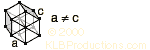
 - Crystal Structure: Hexagonal
- Electron Configuration:
- 1s2 2s2p6 3s2p6d10 4s2
- Electrons per Energy Level: 2,8,18,2
- Ionic Radius: 0.74Å
- Filling Orbital: 3d10
- Number of Electrons (with no charge): 30
- Number of Neutrons (most common/stable nuclide): 35
- Number of Protons: 30
- Oxidation States: 2
- Valence Electrons: 4s2
- Electron Dot Model

- Electron Dot Model

Chemical Properties of Zinc
- Electrochemical Equivalent: 1.22g/amp-hr
- Electron Work Function: 4.33eV
- Electronegativity: 1.65 (Pauling); 1.66 (Allrod Rochow)
- Heat of Fusion: 7.322kJ/mol
- Incompatibilities:
- Ionization Potential
- Valence Electron Potential (-eV): 38.9
Physical Properties of Zinc
- Atomic Mass Average: 65.39
- Boiling Point: 1180K 907°C 1665°F
- Coefficient of lineal thermal expansion/K-1: 25E-6
- Conductivity
- Electrical: 0.166 106/cm

Thermal: 1.16 W/cmK
- Electrical: 0.166 106/cm
- Density: 7.13g/cc @ 300K
- Description:
- Hard, brittle, shiny bluish-white transition metal.
- Elastic Modulus:
- Bulk: 69.4/GPa
- Rigidity: 41.9/GPa
- Youngs: 104.5/GPa
- Enthalpy of Atomization: 129.7 kJ/mole @ 25°C
- Enthalpy of Fusion: 7.32 kJ/mole
- Enthalpy of Vaporization: 115.5 kJ/mole
- Flammablity Class:
- Freezing Point: see melting point
- Hardness Scale
- Brinell: 412 MN m-2
- Mohs: 2.5
- Heat of Vaporization: 115.3kJ/mol
- Melting Point: 692.88K 419.73°C 787.51°F
- Molar Volume: 9.16 cm3/mole
- Optical Reflectivity: 80%
- Optical Refractive Index: 1.00205
- Physical State (at 20°C & 1atm): Solid
- Specific Heat: 0.39J/gK
- Vapor Pressure = 19.2Pa@419.73°C
The d Block Elements
The d block elements fall between the s block and the p block. They share the common characteristics in that the d sublevel of the atom is being filled.
The d block elements include the transition metals. The transition metals are those d block elements with a partially filled d sublevel in one of its oxidations states. Since the s and d sublevels are very close in energy, the d block elements show certain special characteristics including
Multiple oxidation states
The ability to form complex ions
Colored compounds
Catalytic behavior
Magnetic properties
Variable Oxidation States in the d Block
The s block metals such as Na and Ca have s electrons that are easily lost, but the ionization energies of the inner electrons are so high that they are never lost in chemical reactions. Therefore the oxidation number of sodium is always +1 and calcium is always +2
The transition metals have slightly higher effective nuclear charges (more protons). Their first ionization energies are slightly higher than those of the s block. Therefore they are generally less reactive than the alkali metals or the alkaline earth metals
There is no sudden sharp increase in ionization energy as one proceed through the d electrons as there would be with the s block. As a result the d block elements can lose or share d electrons as well as s electrons, allowing for multiple oxidation states.
The d Block elements usually have a +2 oxidation number which corresponds to the loss of the two s electrons. This is especially true on the right side of the d block, but less true on the left. For example Sc+2 does not exist, and Ti+2 is unstable oxidizing in the presence of any water to the +4 state.
Common Oxidation States of the d Block Elements
Sc | Ti | V | Cr | Mn | Fe | Co | Ni | Cu | Zn | ||
7 | X | ||||||||||
6 | X | X | |||||||||
5 | X | ||||||||||
4 | X | X | X | ||||||||
3 | X | X | X | X | X | X | |||||
2 | X | X | X | X | X | X | X | X | |||
1 | X |
Colored ions
In an isolated atom all of the d sublevel electrons have the same energy. If the atom is surrounded by charged ions or polar molecules, the effect of the electric field from these ions or molecules has a slightly different effect on the energies of the various d orbitals and d electrons. The colors of the ions and complex ions of d block elements depends on a variety of factors including:
The particular element
The oxidation state
The kind of ligands bound to the element
The presence of a partially filled d subshell in the element is usually necessary for the ion or complex to show color
Most transition metals that have partially filled d subshells have colored compounds. Those with completely full or completely empty subshells do not, For example Zinc which has a full d subshell. Its compounds are white
A transition metal ion exhibits color when it absorbs visible light with wavelengths ranging from 400-700 nanometers. If the compound absorbs particular wavelengths of light its color is the composite of those wavelengths that it does not absorb.
The d orbitals are usually split up into two groups such as one of the three orbitals at a low energy and one of two orbitals at a higher energy. The difference in energy of these orbitals varies slightly with the nature of the ligand or ion surrounding the metal ion The frequency of the light corresponding to this difference ∆E =hn occurs in the visible region. When white light passes through a compound of a transition metal, light of a particular frequency is absorbed and an electron is promoted from a lower energy d orbital to a higher one.

The light that is reflected appears colored because some of the frequencies of otherwise white light have been absorbed. For example, in copper (II) compounds most of the red and yellow light is absorbed so the compounds have a blue to green color. If there are no electrons in the d orbitals as in then case of Sc3+ or Ti4+ There are no d electrons to move and the compounds are colorless. If the d orbitals are completely full as in the case of Zn2+ there is no space for electrons to move and the compounds are again colorless.
Complex ions
The ions of the d block elements and those of the lower p block have unfilled d or p orbitals. These orbitals can accept electrons from another species, either an ion or polar molecule, to form a dative bond. This attraction results in the formation of a complex ion.
A complex ion is made up of two or more ions or polar molecules joined together. It should not be confused with a polyatomic ion.The molecules or ions that surround the metal ion donating the electrons to form the complex ion are called complexing agents or ligands. Compounds that are formed with complex ions are called coordination compounds
Common ligands

Complex ions usually have either 4 or 6 ligands. The formation of complex ions stabilizes the oxidations states of the metal ion and they also affect the solubility of the complex ion. The formation of a complex ion can also have a major effect on the color of the solution of a metal ion. For example aqueous cobalt salts have a pink color. If concentrated hydrochloric acid is added to the solution, the solution turns blue due to the formation of the tetrachlorocobalt ion CoCl42- .
Catalytic Behavior
Many transition metals and their ions are used for catalysts for other chemical reactions. A catalyst speeds up the rate of a chemical reaction with out itself being consumed. The transition metals form complex ions with species that can donate lone pairs of electrons. This results in close contact between the metal ion and the ligand. Transition metals also have a wide variety of oxidation states so they gain and lose electrons in redox reactions
The d block elements may either heterogeneous or homogeneous catalysts. In a a heterogeneous catalyst the surface of the metal or compound provides an active surface on which the reaction can occur with a reduced activation energy. For example, Manganese (IV) oxide, MnO2, catalyzes the decomposition of hydrogen peroxide in this manner. Nickel and platinum, iron, and vanadium (V) oxide are all important catalysts for industrial processes.
In homogeneous catalysis the catalyst is in the same phase as the reactants. In these reactions a particular metal ion is oxidized in one stage of the reaction and reduced (reformed ) in another stage of the reaction. A good example of this kind of catalysis is the role of Fe2+ and Fe3+ in the reaction of hydrogen peroxide with iodide ion. The iron (II) is oxidized by the peroxide to ion (III). The Iron (III) is then reduced by the iodide ions to reform iron (II).
Magnetic Properties
Molecules with one or more unpaired electrons are attracted into a magnetic field. The more unpaired electrons in the molecule the stronger the attraction. This type of behavior is called paramagnetism. Substances with no unpaired electrons are weakly repelled by a magnetic field. This property is called diamagnetism.
Many transition metal complexes exhibit simple paramagnetism. In such compounds the individual metal ions possess some number of unpaired electrons. It is possible to determine the number of unpaired electrons per metal ion by looking at the degree of paramagnetism.
Transition metal
From Wikipedia, the free encyclopedia
The term transition metal (sometimes also called a transition element) has two possible meanings:
- In the past it referred to any element in the d-block of the periodic table, which includes groups 3 to 12 on the periodic table. All elements in the d-block are metals.
- The modern, IUPAC definition[1] states that a transition metal is "an element whose atom has an incomplete d sub-shell, or which can give rise to cations with an incomplete d sub-shell." Group 12 elements are not transition metals in this definition.
The name transition comes from their position in the periodic table of elements. In each of the four periods in which they occur, these elements represent the successive addition of electrons to the d atomic orbitals of the atoms. In this way, the transition metals represent the transitionbetween group 2 elements and group 13 elements.
Contents[hide] |
[edit]Classification
In the d-block the atoms of the elements have between 1 and 10 d electrons.
| Group | 3 | 4 | 5 | 6 | 7 | 8 | 9 | 10 | 11 | 12 |
|---|---|---|---|---|---|---|---|---|---|---|
| Period 4 | Sc 21 | Ti 22 | V 23 | Cr 24 | Mn 25 | Fe 26 | Co 27 | Ni 28 | Cu 29 | Zn 30 |
| Period 5 | Y 39 | Zr 40 | Nb 41 | Mo 42 | Tc 43 | Ru 44 | Rh 45 | Pd 46 | Ag 47 | Cd 48 |
| Period 6 | La 57 | Hf 72 | Ta 73 | W 74 | Re 75 | Os 76 | Ir 77 | Pt 78 | Au 79 | Hg 80 |
| Period 7 | Ac 89 | Rf 104 | Db 105 | Sg 106 | Bh 107 | Hs 108 | Mt 109 | Ds 110 | Rg 111 | Uub 112 |
Although atoms of scandium and yttrium have a single d electron in the outermost shell, these elements are not usually considered transition metals as all their compounds contain the ions Sc3+ and Y3+ in which there are no d electrons. Lanthanum is usually considered a lanthanideelement and actinium an actinide element.[2]
The electronic structure of transition metal atoms can be written, with a few minor exceptions, as [ ]ns2(n-1)dm, as the inner d orbital has more energy than the valence-shell s orbital. In divalent and trivalent ions of the transition metals the situation is reversed so that the s electrons have higher energy. Consequently an ion such as Fe2+ has no s electrons, it has the electronic configuration [Ar]3d6 as compared with the configuration of the atom, [Ar]4s23d6.
Zinc, cadmium, and mercury are not transition metals.[3] as they have the electronic configuration [ ]d10s2, with no incomplete d shell.[4] In theoxidation state +2 the ions have the electronic configuration [ ] d10. While compounds in the +1 oxidation state, such as Hg22+, are known there are no unpaired electrons because of the formation of a covalent bond between the two atoms of the dimer. Zn, Cd and Hg may be classed as post-transition metals. However, it is often convenient to include these elements in a discussion of the transition elements. For example, when discussing the Crystal field stabilization energy of first-row transition elements, it is convenemt to include the non-transition elements calcium and zinc, as both Ca2+ and Zn2+ have a value of zero against which the value for other transtion metal ions may be compared. Another example occurs in the Irving-Williams series of stability constants of complexes.
There are a number of properties shared by the transition elements that are not found in other elements, which results from the partially filled dshell. These include
- the formation of compounds whose colour is due to d - d electronic transitions
- the formation of compounds in many oxidation states, due to the relatively low reactivity of unpaired d electrons.[5]
- the formation of many paramagnetic compounds due to the presence of unpaired d electrons. A few compounds of main group elements are paramagnetic (e.g. nitric oxide, oxygen)
[edit]Coloured compounds

Colour in transition metal compounds may be due to electronic transitions of two principal types.
- charge transfer transitions. An electron may jump from a predominantly ligand orbital to a predominantly metal orbital, giving rise to a ligand-to-metal charge-transfer (LMCT) transition. These can most easily occur when the metal is in a high oxidation state. The colour of chromate, dichromate and permanganate ions is due to LMCT transitions. A metal-to ligand charge transfer (MLCT) transition will be most likely when the metal is in a low oxidation state and the ligand is easily oxidised. Mercuric iodide, HgI2, is red because of a MLCT transition. As this example shows, charge transfer transitions are not restricted to transition metals.[6]
- d-d transitions. An electron jumps from one d-orbital to another. In complexes of the transition metals the d orbitals do not all have the same energy. The pattern of splitting of the d orbitals can be calculated using crystal field theory. The extent of the splitting depends on the particular metal, its oxidation state and the nature of the ligands. The actual energy levels are shown on Tanabe-Sugano diagrams.
- In centrosymmetric complexes, such as octahedral complexes, d-d transitions are forbidden by the Laporte rule and only occur because ofvibronic coupling in which a molecular vibration occurs together with a d-d transition. Tetrahedral complexes have somehat more intense colour because mixing d and p orbitals is possible when there is no centre of symmetry, so transitions are not pure d-d transitions. Themolar absorptivity of bands caused by d-d transitions are relatively low, roughly in the range 5-500 M-1cm-1 (where M = mol dm-3).[7] Somed-d transitions are spin forbidden. An example occurs in octahedral, high-spin complexes of manganese(II), which has a d5 configuration in which all five electron has parallel spins; the colour of such complexes is much weaker than in complexes with spin-allowed transitions. In fact many compounds of manganese(II) appear almost colourless.
[edit]Oxidation states
A characteristic of transition metals is that they exhibit two or more oxidation states usually differing by one. For example, compounds ofvanadium are known in all oxidation states between -1, e.g. [V(CO)6]- and +5, e.g. VO43-.
Main-group elements in groups 13 - 17 also exhibit multiple oxidation states. The "common" oxidation states of those elements differ by two. For example, compounds of gallium in oxidation states +1 and +3 exist in which there is a single gallium atom. No such compound of Ga(II) is known: any such compound would have an unpaired electron and would behave as a free radical and be destroyed rapidly. However, under the right conditions dimeric compounds such as [Ga2Cl6]2- can be made in which a Ga-Ga bond is formed from the unpaired electron on each Ga atom. [8] Thus the main difference, regarding oxidation states, between transition elements and other elements is that oxidation states are known in which there is a single atom of the element and one or more unpaired electrons.
The maximum oxidation state in the first row transition metals is equal to the number of valence electron from titanium (+4) up to manganese(+7), but decreases in the later elements. In the second and third rows the maximum occurs with ruthenium and osmium (+8). In compounds such as [MnO4]- and OsO4 the elements achieve a stable octet by forming four covalent bonds.
The lowest oxidation states are exhibited in such compounds as Cr(CO)6 (oxidation state zero) and [Fe(CO)4]2- (oxidation state -2) in which the18-electron rule is obeyed. These complexes are also covalent.
Ionic compounds are mostly formed with oxidation states +2 and +3. In aqueous solution the ions are hydrated by (usually) six water molecules arranged octahedrally.
[edit]Magnetism
Transition metal compounds are paramagnetic when they have one or more unpaired d electrons.[9] In octahedral complexes with between four and seven d electrons both high spin and low spin states are possible. Tetrahedral transition metal complexes such as [FeCl4]2- are high spinbecause the crystal field splitting is small so that the energy to be gained by virtue of the electrons being in lower energy orbitals is always less that the energy needed to pair up the spins. Some compounds are diamagnetic. These include octahedral, low-spin, d6 and square-planar d8complexes. In these cases, crystal field splitting is such that all the electrons are paired up.
Ferromagnetism occurs when individual atoms are paramagnetic and the spin vectors are aligned parallel to each other in a crystalline material. Metallic iron and the alloy alnico are examples of ferromagnetic materials involving transition metals. Antiferromagnetism is another example of a magnetic property arising from a particular alignment of individual spins in the solid state.
Subscribe to:
Comments (Atom)
